



Why Some People Never Die: Bo Schembechler’s Legacy and Lessons for All of Us




In this post, we’ve captured the essence of the previous month’s posts on leaving a legacy (Why Some People Never Die, Parts I-III) into a single essay. We hope you find it valuable to keep and share with those you want to help live their life in service of creating a better tomorrow.
What does it mean never to die?
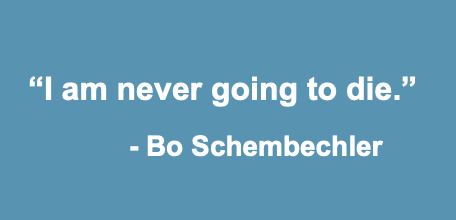
My friend and mentor University of Michigan Football Coach Bo Schembechler once told me, “I am never going to die.” At first, I thought he just wanted to live longer. But as we look back on his life, we see how right he was. Bo lives on through the many people he influenced, the lessons they learned, and the selfless life purpose he inspired. In this essay, we explore how living at Stage IV Fulfillment—committed to creating a better tomorrow—helps us achieve the lasting, ultimate fulfillment.
The Living Legacy of Bo Schembechler
The week before Bo died, he asked me to join him in visiting my former Michigan Football teammate Tom Slade, who was in his final days fighting cancer. It was emotional to see Bo gently rub Tom’s arm, even though Tom was unresponsive. Later, after a discussion about the last days of our lives, Bo looked me straight in the eyes and said, “I am never going to die!”
At a recent Rose Bowl Legacy Foundation event honoring Bo where some of his players shared what he meant to them, I shared this story with Eileen Weiser, wife of my teammate Dick Calderazzo. She reflected, “Bo never did die; did you hear in the stories just told that he continues to have an impact today?”
 Bo’s legacy endures not through his wins, but through the lives he influenced, the teams he forged, and the lessons he shared. Legacy isn’t about statues or trophies. Those fade. What truly lasts is the spirit he ignited in others—helping them see a better version of themselves and motivating them to serve something greater that only a team can accomplish.
Randy Winograd, a member of the Rose Bowl Legacy Board, shared that a Michigan student encountered Bo while walking his dog, and the two conversed for a while. The student mentioned that he was having issues with his dad. Bo challenged him to make things right with his father.
Decades later, the man hearing about Bo’s Rose Bowl recognition, shared, “As a result of Bo’s challenge, my dad and I were business partners for more than 20 years. For the past 50 years, I have tried to live my life in a way that Bo would be proud of me.”
That is how we never die.
The Science and Spirit of Lasting Influence
 At the Rose Bowl ceremony, one theme was clear: Bo’s influence went beyond football. Michigan Athletic Director Warde Manuel summed it up: “[Bo’s mantra] ‘The team, the team, the team’ has meaning beyond sports and is what we should strive for in life. To make things better, to be successful, to drive success in others, not only in yourself, but to be champions of other people.”
This is Stage IV Fulfillment – living in service of something greater than ourselves. At FS/A, we describe four stages of fulfillment:
- Stage I Fulfillment ‒ Meeting our primary needs
- Stage II Fulfillment ‒ Learning, growing, competing
- Stage III Fulfillment ‒ Benefiting others
- Stage IV Fulfillment ‒ Creating a better tomorrow
As my former teammate Dick Caldorazzo put it, “He challenged every one of us to go farther, to try harder, dream bigger, be better, and to be worthy of playing for Michigan. He wanted us to become good spouses, good fathers, good friends, and good citizens.”
Neuroscience explains this. During Stages I‒III Fulfillment, stress hormones dominate. In Stage IV, oxytocin (trust), serotonin (joy), and balanced dopamine (achievement) foster peace, energy, and connection. That’s why people with a legacy purpose radiate energy that inspires others.
Bo’s influence endures because he lived at Stage IV, shaping not just athletes for Saturday but people for a lifetime.
Leaving the World a Better Place Because We Lived
 The most moving stories from the Rose Bowl ceremony weren’t about victories, they were about Bo’s compassion, compassion in life’s most challenging moments.
Rich Hewlett, one of Bo’s quarterbacks, said, “If you played or coached for Bo, you were important to him. He stood by us in tough times—job losses, health issues, funerals. He stood by us in good times—our weddings, our children, our causes.”
Legacy is often lived in small moments. When Hewlett’s wife faced cancer, Bo and his wife, Cathy, spent the following weekend’s football Saturday at their home and in the Michigan press box, showing the boys they were loved and safe.
Another one of Bo’s Rose Bowl quarterbacks, John Wangler, said that a stranger, noticing his Michigan Football shirt, asked him if he played for Bo Schembechler. “I just want to shake the hand of the man who shook the hand of Bo Schembechler.”
Integrity, courage, and love ripple further than we can see.
As Caldorazzo also shared, “He guided us through getting from boys to men through his principles of honesty, integrity, respect, and honor . . . He was molding us into ‘the team, the team, the team’ and he was laying the foundation for each one of us to be successful after our playing days were over.”
That is what it means never to die: Our presence endures in the people we’ve helped, supported, and inspired.
Some Examples of Living to Create a Better Future
There are so many more stories that could have been told; let me share a few I experienced with Bo.
Assistant Coaches First
During Bo’s 20-year tenure as head football coach at Michigan, salaries for even the most winning college football coaches were a small fraction of the amounts earned today, and their coaching staffs earned far less. To supplement their own modest salaries, the coaches ran an annual week-long football camp for high school students hosted by Michigan. The camp earned enough for the equivalent of a month’s salary for each coach. Bo chose not to accept any payment from the camp, making sure his coaches were taken care of first.
Assistant Coaches’ Children Second
When we negotiated our first Nike contract, it was customary for the agreement to be with the head football coach rather than the university. With that contract and each one afterward, Bo instructed me to develop an algorithm to compensate the coaches based on the number of children they had, their ages, and whether they were in college, to establish a college fund for each child. Even when Bo’s own son, Shemy, became a freshman, Bo took no compensation from the contract; 100% of it went go directly to the assistant coaches for the good of their children.
Integrity Above All Else
Assistant coach Cam Cameron was an outstanding recruiter. But when Cameron secured J.J. Flanagan, then the top-ranked running back coming out of high school, Bo surprised Cam and me (the recruiting coordinator) on a phone call with Flanagan about his commitment.
 Bo said he had just been talking to Bill McCartney, the head football coach at the University of Colorado, who told him Flanagan had committed to Colorado. Flanagan then told us they had hired his high school coach, hoping he would commit to Colorado, but he ultimately wanted to attend Michigan. Bo asked, “Did you tell the people at Colorado you would go there?” Flanagan responded, “Not really.” Bo said, “Let’s talk tomorrow. Think about what you said and call me tomorrow. If you didn’t, you’re welcome to come to Michigan. If you did, you need to go to Colorado.” Flanagan called back the next day and confirmed that he had committed to Colorado and would be going there. Bo said, “Congratulations, we wish you well.”
Closing Reflection: Living with a Legacy Purpose
The Shift from Me to Team makes the case that true greatness is sustainable only when we live for a purpose beyond ourselves. Stage IV Fulfillment is how legacy is created — through service, compassion, and courage. And we enjoy our lives more when we can be in the world for others.
In his later years, you could often hear Bo saying, “How do people have bad days?! You get to smell the fresh morning air, hear the birds singing, and answer the phone to help those who need you. How can people say they’re having a bad day?”
That is what living life in service of a better tomorrow can do for us. Bo’s words were bold, but they were true: “I am never going to die.” And neither will we̶, if we live to leave the world a better place.
Reflection Questions for All of Us
- What is my legacy purpose?
- What timeless GuidingPrinciples have I demonstrated?
- Who do I care most about being able to live the fulfilled life they deserve?